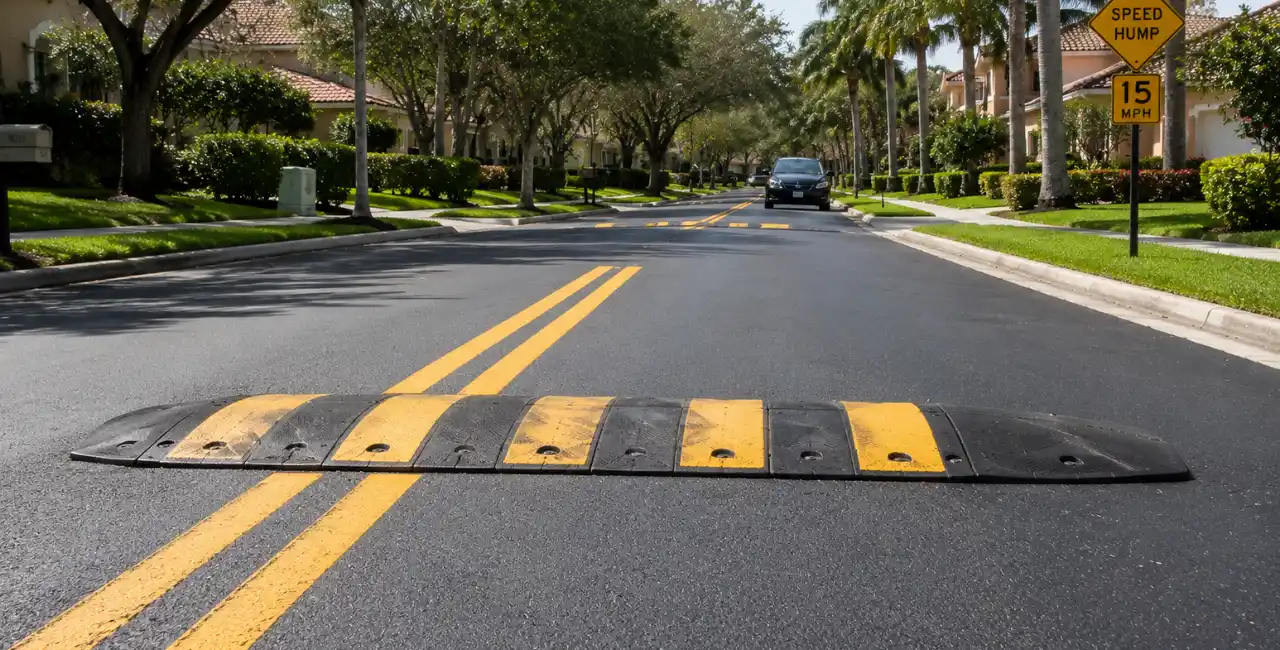
In Miami’s residential communities, speeding vehicles are one of the most common safety concerns reported by homeowners associations (HOAs), apartment complexes, and private neighborhood developers. As traffic volume increases and neighborhoods become more densely populated, controlling vehicle speed is no longer optional – it is essential for protecting pedestrians, cyclists, and property.
Asphalt speed humps are one of the most effective traffic-calming solutions used across South Florida. Designed and installed by experienced contractors such as Southern Asphalt Engineering, they help enforce safe driving speeds in areas where traditional signage alone is not enough.
Unlike temporary warning signs, speed humps create a physical driving condition that forces compliance. This makes them one of the most reliable and long-lasting solutions for neighborhood traffic safety.
What Are Asphalt Speed Humps and How Do They Work?
Asphalt speed humps are raised sections of pavement installed across the width of a roadway or parking area. Their purpose is to slow vehicles to a safe speed by creating a controlled vertical rise that drivers must navigate carefully.
In most residential applications, speed humps are designed to:
- Slow vehicles to approximately 10–20 mph
- Improve safety in pedestrian-heavy areas
- Reduce aggressive driving and cut-through traffic
- Encourage consistent, predictable driving behavior
Unlike sharp speed bumps used in parking lots, speed humps have a longer, more gradual slope. This allows vehicles to pass smoothly at safe speeds while discouraging speeding without causing abrupt stops or damage to vehicles.
According to transportation safety research, properly designed speed humps can reduce vehicle speeds by nearly 10 mph and significantly improve safety outcomes in residential areas.
Why Miami Neighborhoods Need Traffic-Calming Solutions
Miami presents unique traffic challenges for residential communities. Warm weather, tourism activity, and dense urban development contribute to higher-than-average vehicle movement in and around neighborhood streets.
Common safety issues include:
- Drivers using residential streets as shortcuts
- Speeding in HOA-managed communities
- Limited enforcement presence in private roads
- High pedestrian activity near homes, parks, and schools
- Increased risk of accidents involving children and pets
Without physical traffic calming measures, these issues often persist even when speed limit signage is clearly posted. Asphalt speed humps address the problem directly by modifying driver behavior at the physical level.
How Asphalt Speed Humps Improve Safety Outcomes
Speed humps are not just about slowing vehicles – they actively reshape driving patterns within a community. When installed correctly, they create safer and more predictable traffic conditions.
Key safety improvements include:
- Reduced likelihood of high-speed collisions
- Improved pedestrian crossing safety
- Lower risk of injury severity in accidents
- Discouragement of reckless driving behavior
- Better visibility and awareness in shared road spaces
Research shows that traffic calming devices like speed humps are especially effective in residential environments where pedestrian activity is high and low-speed travel is essential for safety.
In Miami communities, this is particularly important because many neighborhoods are designed with shared spaces, walkable streets, and limited separation between vehicles and pedestrians.
The Role of Professional Installation in Effectiveness
The effectiveness of asphalt speed humps depends heavily on proper design and installation. Poorly constructed humps can lead to driver frustration, vehicle discomfort, or even safety hazards.
Professional contractors such as Southern Asphalt Engineering ensure that speed humps are:
- Built to correct height and length specifications
- Properly spaced for traffic flow optimization
- Installed with durable asphalt materials suited for Florida heat
- Aligned with drainage and roadway structure requirements
- Clearly marked for visibility and safety compliance
Proper engineering ensures that speed humps slow traffic without creating unnecessary disruption for emergency vehicles or daily residents.
Asphalt Speed Humps vs Other Traffic-Calming Methods
HOAs and property managers often consider multiple traffic-control solutions before choosing speed humps. While signage and painted markings can help, they rely on driver compliance, which is not always reliable.
Asphalt speed humps offer a more consistent solution because they physically require drivers to reduce speed.
Other methods include:
- Speed limit signs (limited effectiveness alone)
- Painted crosswalk warnings (visual only)
- Radar feedback signs (behavioral influence but not physical)
- Stop signs (can create unnecessary stopping and idling)
Among these, asphalt speed humps remain one of the most cost-effective and long-term solutions for residential traffic control.
Asphalt Speed Hump Safety Impact Overview
| Safety Factor | Without Speed Humps | With Asphalt Speed Humps |
| Average Vehicle Speed | High variability | Controlled and reduced |
| Pedestrian Safety | Higher risk exposure | Significantly improved |
| Cut-through traffic | Common issue | Reduced likelihood |
| Accident severity | Higher due to speed | Lower due to reduced speed |
| Driver behavior consistency | Unpredictable | More uniform compliance |
This comparison highlights how physical traffic-calming measures significantly improve overall neighborhood safety compared to relying on signage alone.
Additional Benefits for HOA and Residential Communities
Beyond safety, asphalt speed humps provide several long-term advantages for Miami communities:
Improved Quality of Life
Slower traffic reduces noise levels and creates a calmer neighborhood environment.
Increased Property Value
Communities perceived as safe and well-managed tend to attract higher property values.
Better Community Reputation
Well-maintained traffic safety features reflect positively on HOA management.
Reduced Liability Risk
Lower vehicle speeds reduce the likelihood of accidents and potential legal claims involving pedestrian injuries or property damage.
Why Asphalt Is the Preferred Material in Miami
Asphalt is widely used for speed hump construction in South Florida because it performs well in hot and humid climates. Compared to other materials, asphalt offers:
- Strong durability under heavy traffic
- Resistance to Florida heat expansion
- Seamless integration with existing pavement
- Lower long-term maintenance requirements
- Professional, uniform appearance
These characteristics make asphalt speed humps ideal for long-term neighborhood infrastructure.
The Benefits of Asphalt Speed Humps for Safer Miami Neighborhoods
Asphalt speed humps are one of the most effective and practical traffic-calming solutions for Miami neighborhoods. By physically reducing vehicle speeds, they significantly improve pedestrian safety, reduce accident risks, and create more livable residential environments.
For HOAs, property managers, and community developers, investing in professionally installed asphalt speed humps is not just a safety upgrade – it is a long-term investment in community quality and resident well-being.
Companies like Southern Asphalt Engineering specialize in designing and installing durable asphalt speed humps tailored to the unique traffic and climate conditions of South Florida, helping neighborhoods stay safer, calmer, and more organized.
FAQs
What is the main purpose of asphalt speed humps?
Asphalt speed humps are designed to slow down vehicles and improve safety in residential neighborhoods, especially in HOA-managed communities.
How do speed humps improve safety in Miami neighborhoods?
They reduce speeding, lower accident risks, and create safer conditions for pedestrians, children, and pets in residential areas.
Are asphalt speed humps better than speed bumps?
Yes, speed humps have a gradual slope that allows smoother traffic flow while still reducing speed, making them safer for residential roads.
Where are asphalt speed humps typically installed?
They are commonly installed in HOA communities, school zones, private roads, apartment complexes, and parking areas with high pedestrian activity.
Do asphalt speed humps require maintenance?
Yes, periodic inspections and minor repairs may be needed to maintain visibility, structure, and effectiveness over time.